
Image
Displaying 191 - 200 of 488
The subject of investigation in this study is the principles of foster care, including the assumptions and solutions.
This article compares how the global policy of deinstitutionalisation (DI) of child welfare travelled, was translated and institutionalised in two post-Soviet countries – Russia and Kazakhstan.
Using 20-year follow-up data from a unique natural experiment – the large scale adoption of children exposed to extreme deprivation in Romanian institutions in the 1980s – the authors of this paper examined, for the first time, whether such deficits are still present in adulthood and whether they are associated with deprivation-related symptoms of attention-deficit/hyperactivity disorder (ADHD) and autism spectrum disorder (ASD).
This report maps and assesses the forms of care provided to unaccompanied migrant, asylum-seeking and refugee children in six European Union Member States: Bulgaria, France, Italy, Greece, the Netherlands and Spain.

In this study, the authors examined (a) whether institutional rearing is associated with continued social communication (SC) deficits into adolescence; (b) whether early placement into foster care mitigates risk for SC problems; and (c) associations between SC and psychopathology from middle childhood (age 8) to adolescence (age 16).
This study examined the behavioral adjustment of 52 Romanian adolescents domestically adopted.
A cross-sectional survey was undertaken to estimate the prevalence of child maltreatment and adverse childhood experiences in the Czech Republic, as data on these is scarce.
The study substantiates the organizational, psychological, pedagogical and socio-legal principles of creating a safe educational environment for children deprived of parental care, providing the proper conditions for their socialization, harmonious physical, mental, moral and volitional, and spiritual development.
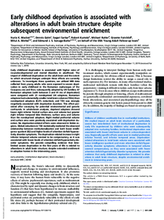
To investigate the impact of childhood deprivation on the adult brain and the extent to which structural changes underpin these effects, the authors of this study from PNAS utilized MRI data collected from young adults who were exposed to severe deprivation in early childhood in the Romanian orphanages of the Ceaușescu era and then, subsequently adopted by UK families.
This chapter traces and explains responses to deinstitutionalisation reforms in the Russian regions. Three parallel policy shifts are taken into account: deinstitutionalisation (DI), public sector reform, and social provision reform.