Image
Displaying 81 - 90 of 488
Under the auspices of the Ukraine Children’s Care Group, one of two learning events were held in July and September 2022. This event, "Addressing the need for foster care in the context of the Ukraine crisis", was held on September 7th in collaboration with HDPI. It focused on better understanding the foster care systems and services in Ukraine and neighbouring countries hosting Ukrainian refugee children, specifically Poland, Romania, and Moldova.
The aim of this study was to investigate (a) the extent to which child maltreatment co-occurs with parental separation and (b) associations between different types of child maltreatment and various types of separation-associated interparental conflict. This cross-national comparative study on family dynamics was based on National survey data of the US, Russia and 17 European countries indicates that in these countries 10–44% of the couples with children had separated before one of their children reached the age of 15 years.
The purpose of this study was to establish the prevalence of adverse childhood experiences (ACEs) in child residential care and to explore predictors of accumulation and clustering patterns.
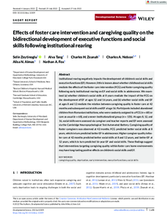
Institutional rearing negatively impacts the development of children's social skills and executive functions (EF). However, little is known about whether childhood social skills mediate the effects of the foster care intervention (FCG) and foster caregiving quality following early institutional rearing on EF and social skills in adolescence. Participants included abandoned children from Romanian institutions
On 7 July 2022, the Better Care Network (BCN) and Disability Rights International (DRI) organised an event with disability and child protection actors focused on the situation of children with disabilities in residential care in Ukraine (including those children who have been returned to families or evacuated from facilities since 24 February 2022).
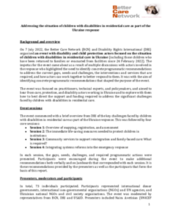
The aim of this guidance document is to provide a framework to support child protection practitioners and policymakers working both inside Ukraine and in host countries to implement responses related to children’s care in the context of Ukraine in line with international standards and good practice on children’s care and the provision of alternative care.

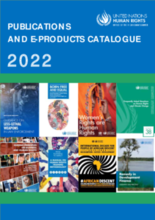
The Office of the United Nations High Commissioner for Human Rights (OHCHR) produces an extensive range of publications and e-products on a variety of human rights-related subjects. This broad portfolio provides information of interest to governments, national institutions, civil society, academia, the general public and the media, among other stakeholders. OHCHR publications and e-products aim to increase knowledge and raise awareness about human rights and fundamental freedoms, and to publicize ways of promoting and protecting them worldwide. They also seek to encourage debate on topical human rights issues under discussion at the United Nations.
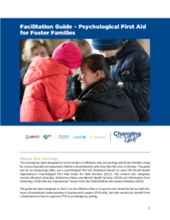
This training has been designed for social workers in Moldova who are working with foster families caring for unaccompanied and separated children and adolescents who have fled the crisis in Ukraine.
Since the onset of the war in Ukraine, a number of people fleeing from Ukraine to neighbouring countries has been observed. This report presents findings based on cumulative and daily registrations, by the General Inspectorate for Border Police (GIBP), since 24 February 2022 onwards, of movement flows of Ukrainian refugees and third-country nationals (TCNs) entering from Ukraine to the Republic of Moldova from all Border Crossing Points (BCPs) and exiting the country from all BCPs, towards Romania and towards Ukraine, as well as via flights. In addition, it presents data on those who entered since 24 February and are still present in the country.

Această instruire a fost concepută pentru asistenții sociali din Moldova care lucrează cu asistenții parentali profesioniști care au în plasament copii și adolescenți neînsoțiți și separați, veniți aici din cauza crizei din Ucraina.